Our latest articles
Articles de blog
Escomatic Bar Turning: The Process at the Heart of High-Volume Precision Manufacturing
Tom Hauët
15/6/2026
Summary
Escomatic Turning: The Process at the Heart of High-Volume Precision Manufacturing
Looking to produce shafts, pins or turned parts in small diameters, with consistent precision, at volumes of several hundred thousand pieces? Escomatic turning is probably the answer to your requirements. At LGC Industries, we operate 43 Escomatic machines every day to produce over one million parts per day, serving the automotive, mechatronics, medical and construction industries. In this article, we explain what this process actually involves, how it differs from conventional CNC turning, and why it is particularly well suited to your high-volume production needs.
What is Escomatic turning?
The term "Escomatic" refers to a machine tool technology developed in the 1950s by Swiss company ESCO SA. Its principle is based on an inversion of conventional turning: the material stays fixed while the tools rotate around it.
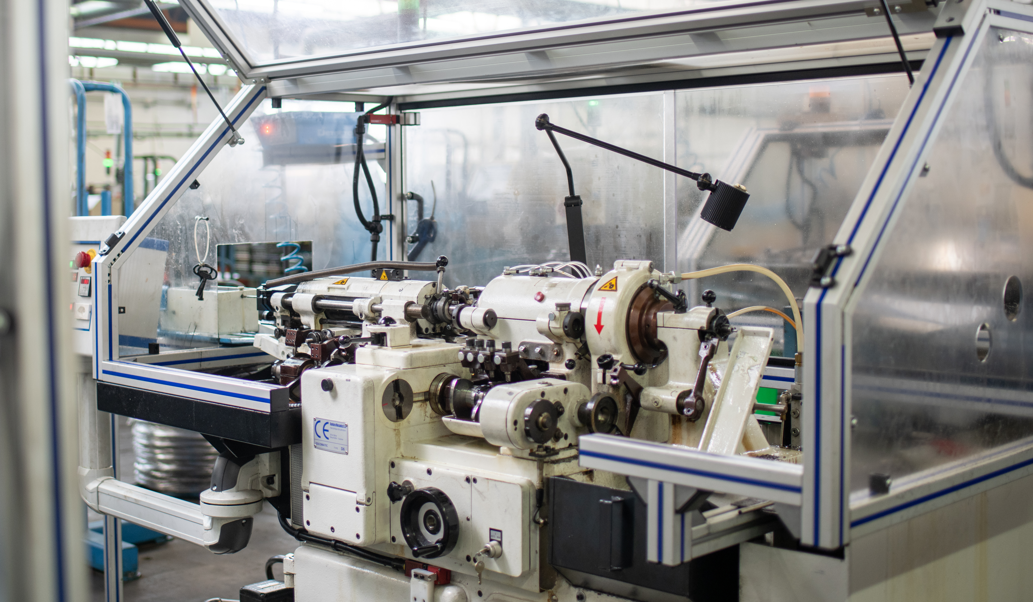
In practice, the raw material is fed as wire on a coil. The rotating working head carries the cutting tools, which perform turning, drilling, threading or knurling in a continuous cycle. This configuration delivers considerable advantages as soon as you are working with small dimensions and large production runs.
Escomatic vs conventional CNC turning: what are the differences?
The fundamental difference lies in the cutting principle: on a conventional CNC lathe, the part rotates while the tool stays fixed. On an Escomatic machine, it is the opposite — the material stays still and the rotating tools work around it. This inversion enables continuous coil wire feeding, whereas a CNC lathe consumes bar stock with a bar feeder.
In terms of working range, Escomatic covers diameters from Ø 0.2 mm to 6 mm, on simple geometries such as shafts, pins and studs. CNC lathes take over beyond 6 mm and for more complex or asymmetrical shapes. On small diameters in large series, Escomatic achieves tolerances of ±5 µm with a cycle speed and unit cost that conventional CNC turning cannot match at equivalent volumes.
In short: if your part has a small diameter, a relatively simple shape and is ordered in large quantities, Escomatic offers a precision-to-cost ratio that no conventional CNC lathe can match.
What operations can be performed on an Escomatic machine?
Contrary to what one might assume, Escomatic is not limited to simple turning. Thanks to its cross-spindle and interchangeable toolheads, a single machine can carry out the following operations in the same cycle:
- Turning (outer profile, chamfers, radii)
- Axial drilling
- Threading and tapping
- Knurling
- Lateral milling
- Bending (for angled shafts)
- Surface matting
This multi-operation capability in a single pass eliminates secondary machining, reduces cycle times and guarantees repeatable accuracy across an entire batch. It is particularly valuable for parts that require grooving directly after Escomatic turning.
What materials can be machined on Escomatic?
Most metals available as coil wire are compatible with the Escomatic process. At LGC Industries, we routinely work with:
- Free-cutting steels (C10, C15, 42CrMo4)
- Stainless steel A2 (304) and A4 (316)
- Brass
- Aluminium
- Copper
The choice of material directly influences the achievable tolerances and cutting conditions. Our technical team advises you on the optimal grade for your functional, thermal and environmental requirements (REACH / RoHS compliance).
What parts does LGC Industries produce on Escomatic machines?
Escomatic machines are central to the production of several LGC part families:
- Machined metal shafts: smooth or knurled axles, produced from coil wire, diameters Ø 0.2 to 6 mm.
- Cylindrical pins ISO 2338 / DIN 7: precision positioning and assembly parts, turned on Escomatic before optional finishing. See our cylindrical pin range.
- Ground pins ISO 8734 / DIN 6325: Escomatic turning followed by centreless grinding to achieve the tightest tolerances (h6, m6). See our ground pin range.
- Grooved pins ISO 8740, 8742, 8743…: Escomatic forms the base cylinder, then our grooving machine creates the 120° grooves by cold plastic deformation. See our grooved pin range.
- Custom parts: specific geometries outside DIN/ISO standards, manufactured to your drawings. See our custom parts.
These parts are then, depending on customer specifications, subjected to grinding (plunge or through-feed), surface treatment, and 100% inspection on our automatic measuring machines with a target of 0 PPM.
Escomatic turning for your spacers and bushings
Escomatic is not limited to pins alone. The process is also used in the manufacture of our plain spacers and ground bushings in small diameters, where the combination of Escomatic turning and grinding achieves the surface finishes and functional dimensions required by the automotive and mechatronics industries.
For applications requiring an internal thread, we complement our range with our Intervis® threaded inserts, produced on a dedicated machine park.
From what volume does Escomatic become cost-effective?
The process is economically advantageous from a few tens of thousands of parts, and becomes the optimal choice for runs of 100,000 parts and above, thanks to its very short cycle times. Below this threshold, a conventional CNC lathe or multi-spindle machine is often more appropriate — our technical team will guide you towards the most competitive solution based on your actual volume.
Why choose LGC Industries for your Escomatic project?
LGC Industries has been manufacturing precision fasteners and assembly components in large series since 1934. Our Escomatic machine park is part of a complete production facility that also includes 25 multi-spindle lathes, 38 grooving machines and 9 grinding machines, enabling us to handle your entire range — from the raw turned blank to the finished part ready for assembly.
Our IATF 16949, ISO 9001 and Ford Q1 certifications demonstrate our quality standards, recognised by customers such as Bosch, Continental, Renault, Stellantis and Schneider Electric. Our target: 0 PPM on every run.
Do you have a requirement for custom turned parts in small diameters? Contact our sales team for a technical review and a quote within 48 hours.
FAQ — Escomatic turning
What is the difference between an Escomatic machine and a conventional automatic lathe?
On a conventional lathe, the workpiece rotates and the tool is fixed. On an Escomatic machine, it is the other way around: the material (as coil wire) stays fixed and the tools rotate around it. This configuration enables very short cycle times, continuous material feeding and high repeatability on small diameters. To learn more about all our manufacturing processes, visit our bar turning page.
What materials can be machined on Escomatic?
Steel, stainless steel, brass, aluminium, copper — most metals available as coil wire are compatible. The choice of material influences the achievable tolerances and cutting conditions.
From what volume does Escomatic become relevant?
The process is economically advantageous from a few tens of thousands of parts, and becomes the optimal choice for runs of 100,000 parts and above.
Are custom parts outside DIN/ISO standards possible?
Yes. LGC produces both standard and fully custom parts to your drawings. Our technical team assesses feasibility and proposes design-for-manufacture optimisations where needed.
What finishing options are available after Escomatic turning?
Depending on requirements, the part can undergo centreless grinding (for h6/m6 tolerances), grooving or surface treatment. All these operations are performed in-house at LGC.
.png)